
- By Charlotte Brown
- June 09, 2026
Practical strategies for executive chefs and operators to cut prep time, reduce labor cost, and maintain the quality that defines your kitchen.
You didn't get into this industry to spend Saturday mornings watching your most skilled line cook break down sixty pounds of protein that could have arrived portioned and ready. Yet that's exactly how most kitchens operate — and it's costing you more than you think.
Labor is now the highest controllable cost in food service, accounting for 30–35% of revenue in full-service restaurants. Of that, prep labor alone eats 35–40% of total kitchen hours. That's not a small inefficiency. It's a structural problem, and smarter food prep solutions are the most direct way to address it.
This isn't about cutting corners. It's about directing your team's talent toward the work that creates guest value: execution, presentation, and the finishing touch that no pre-made product can replicate. Here's how leading operators are doing it.
Why Traditional Prep Models Are Breaking
The staffing environment has fundamentally shifted. The Bureau of Labor Statistics reports that restaurant job openings have consistently exceeded the number of available workers since 2022, with turnover rates in food service hovering near 75% annually.
Meanwhile, guest expectations for speed have accelerated. Most diners say the pace of service directly influences whether they return to a restaurant. And peak-hour consistency (the ability to put out the same plate at ticket 12 as you do at ticket 112) remains one of the hardest operational challenges in the industry.
The old answer was "hire more skilled people." That answer no longer works at scale.
The real cost of from-scratch prep:
Walk through your current prep list and assign an honest hourly cost to each task.
- Butchering protein cuts: 45–90 minutes per service for a skilled cook at $28–36/hour.
- Making stocks from scratch: 6–8 hours of active and passive kitchen time.
- Preparing pastry bases for dessert service: 2–3 hours, requiring pastry-trained staff.
These are legitimate chef skills, but they are also high-cost inputs applied before a single guest has been seated.
The 6 Prep Categories Worth Outsourcing — And How to Do It Right
Not every prep task is equal. The goal isn't to outsource everything. It's to identify where outside expertise and economies of scale can match or exceed your in-house capability, freeing your team for high-impact work.
1. Protein
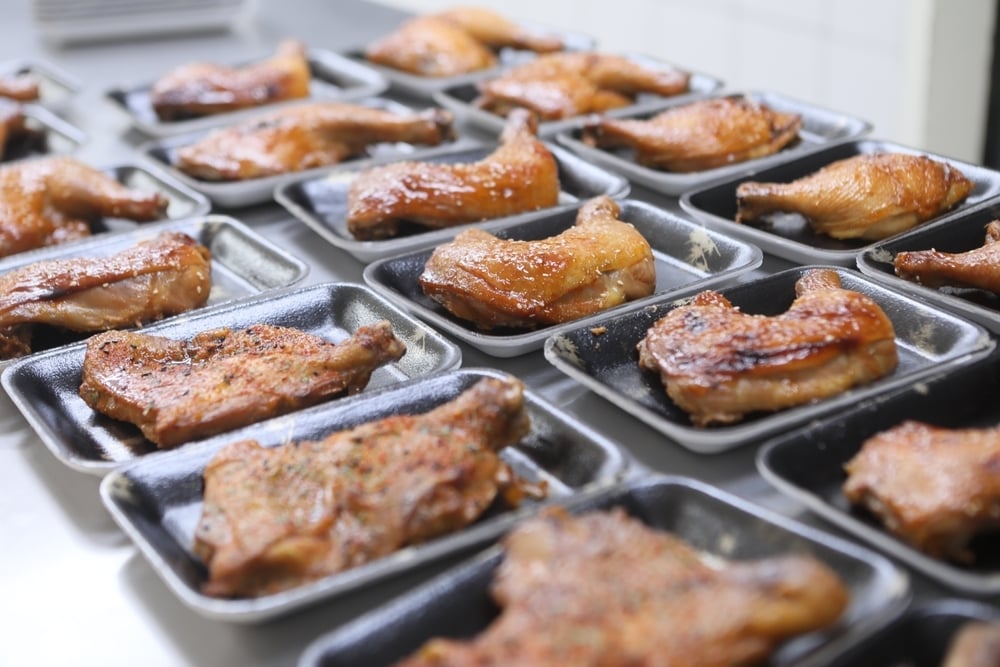
Pre-portioned & par-cooked proteins
Precision-portioned proteins reduce fabrication time and bring portion cost variance under control. For high-volume proteins like beef tenderloin medallions or airline chicken, pre-portioning can cut prep labor by 60–70% while improving consistency.
Look for IQF (individually quick-frozen) options that maintain cell structure on thaw.
2. Sauces & Stocks
Artisan-quality bases and demi-glaces
A professionally made demi-glace or brown veal stock from a quality supplier will often outperform what most kitchens can produce under time pressure. The key differentiator: clean ingredient lists with no added starch, corn syrup, or artificial flavor. Finish and season in-house to maintain your voice.
3. Pastry
Ready-to-use pastry components
From pâte feuilletée and tart shells to crème pâtissière and dacquoise bases, pastry is where prep time compounds fastest. Each requires precision and time.
High-quality, ready-to-bake or ready-to-use versions enable non-pastry-trained staff to execute at pastry standards. Dessert ticket time drops by 40–50% with this shift.
4. Produce
Pre-cut and cleaned produce
IQF vegetables and pre-cut aromatics eliminate the lowest-skill, highest-volume prep task in most kitchens. This isn't just a time win — it's a food safety win. Pre-washed, cut-to-spec produce reduces the risk of cross-contamination and delivers a consistent yield per unit, directly improving food cost predictability.
5. Specialty Ingredients
Artisan charcuterie & cheese components
House-made charcuterie programs are a significant investment in labor and equipment. For operators offering charcuterie boards or composed starters, sourcing from artisan producers eliminates the need for curing, aging, and cold storage logistics.
How to Audit Your Kitchen for Prep Inefficiency
Before you change your ordering, you need data. Run a prep-time audit for two weeks: have each station log the time spent on each prep task at the start and end of every service. The results are almost always surprising.
- Identify your top 10 prep tasks by total weekly hours. These are your highest-leverage targets for process change.
- Calculate fully-loaded cost per task: (time in hours) × (cook's hourly rate including benefits) + ingredient cost. Compare with the landed cost of a quality-prepared alternative.
- Score each task on skill dependency: Does it require a trained culinarian, or could a well-trained prep cook execute it? High-skill, low-volume tasks are prime candidates for outsourcing.
- Assess consistency variance: Which tasks produce the most re-fires or inconsistency complaints? Prep variability is often the hidden driver of mid-service breakdowns.
- Map against your highest-traffic service windows. Tasks that fall in the two hours before peak service are your most dangerous bottlenecks — these need to be either eliminated or systematized first.
Real-World Impact: What Operators Report
Operators who systematically shift 25–35% of prep to ready-to-use and semi-prepared products consistently report: a 15–20% reduction in prep labor, ticket times that improve by 2–4 minutes per cover during peak service, and a meaningful reduction in mid-service re-fires tied to prep inconsistency.
Maintaining Quality When You're Not Making Everything From Scratch
This is the concern every serious chef raises, and rightfully so. The wrong implementation of food prep solutions absolutely can degrade quality.
The right implementation elevates your kitchen's output. The difference lies in three principles:
1. Source like you cook: provenance and ingredient integrity matter
The shortcut isn't buying commodity prepared foods. It's partnering with suppliers who apply the same standards to their products that you apply to yours.
When evaluating any semi-prepared ingredient, read the ingredient list before you read the price. If it contains modified starches, hydrolyzed proteins, or artificial flavor, it's not a quality product.
2. Apply your craft at the finishing stage
The guest's experience is most shaped by the last 20% of preparation: the sear on the protein, the gloss of the sauce reduction, or the precision of the plate.
When you redirect prep hours to finishing work, guest perception of quality typically improves because your team is less fatigued, less rushed, and focused on the work that's most visible.
3. Build a chef's narrative around your sourcing
Sourcing from an artisan charcutier in France or a small-batch cheese producer isn't a compromise — it's a story. Guests respond to provenance.
"Our charcuterie is sourced from a third-generation producer in Alsace" is a stronger table narrative than "made in-house" when the in-house product can't consistently match it. Let your sourcing become part of your culinary identity.
Menu Engineering: Design for Prep Efficiency
The most forward-thinking operators aren't just changing their prep approach — they're designing menus around it. Menu engineering for prep efficiency means asking a different question during development: not just "how does this taste?" but "how does this scale?"
Specifically, consider building menus that share prep components across multiple dishes. For example, a high-quality chicken jus used in three dishes (a braise, a sauce, a soup) yields a 3x ROI on that ingredient. A puff pastry component that serves as the base of both a savory appetizer and a dessert tart eliminates a separate prep line.
This kind of component-based menu design, popularized by operations-focused chefs like David Kinch and Marcus Wareing, is now standard in any kitchen that prioritizes both quality and efficiency.
What Separates a Supplier from a True Kitchen Partner
When evaluating vendors, hold them to the same standards you'd hold your own team:
- Ingredient transparency: Can they provide full ingredient lists and nutritional data on demand? If not, pass.
- Production standards: Are their facilities HACCP-certified? Do they apply the same temperature, time, and cross-contamination controls you do?
- Culinary expertise: Does their team include trained culinary professionals who understand how their products integrate into professional kitchen workflows? Or are they purely a food manufacturing operation?
- Consistency documentation: Can they provide Brix measurements, pH data, and shelf-life specifications? Consistency in their product is the foundation of consistency in yours.
- Custom capability: Can they accommodate spec modifications — such as specific salt levels, custom packaging, or unique flavor profiles — as your volume grows?
Not every supplier offering prepared products is equipped to be a partner to a serious kitchen.
Frequently Asked Questions
What are food prep solutions for restaurants?
Food prep solutions are ready-to-use, par-cooked, or semi-prepared ingredients and products that reduce the time, labor, and skill required for back-of-house preparation. Examples include pre-portioned proteins, artisan-quality sauces, cleaned and cut produce, and ready-to-pipe pastry creams — allowing kitchen teams to focus on finishing and service rather than raw prep.
How much can smarter food prep solutions reduce prep time?
Kitchens that strategically shift 25–35% of prep tasks to high-quality semi-prepared products typically see total prep labor reductions of 15–20%. For individual tasks — protein fabrication, pastry production, stock-making — the time reduction can reach 60–70%. The key is targeting your highest-volume, most labor-intensive tasks first.
Do semi-prepared ingredients compromise dish quality?
Not when sourced from artisan-quality suppliers with clean ingredient standards. Premium semi-prepared products are crafted to chef specifications and allow culinary teams to apply their skills at the finishing stage, where quality is most visible to guests. The risk of quality compromise comes from sourcing commodity-grade products, not from the concept of preparation itself.
Which prep tasks should restaurants keep in-house vs. outsource?
Keep in-house: tasks that are direct differentiators of your culinary identity, finishing work that requires real-time judgment, and anything where your in-house product genuinely exceeds what any supplier offers. Outsource: high-volume, labor-intensive base preparations (stocks, proteins, pastry bases) where a specialist supplier can match or exceed quality at lower total cost.
How do I evaluate whether a food prep solution is worth the cost?
Calculate fully-loaded in-house prep cost: (task time in hours) × (cook's hourly rate + benefits) + ingredient cost + waste factor. Compare that to the landed cost of a quality prepared alternative. In most cases, when true labor cost is factored in, prepared alternatives at premium price points still produce net savings — plus the consistency and scalability benefits don't appear in the raw cost comparison.
Ready to Build a More Efficient Kitchen?
The most successful operators are finding ways to protect their teams' time while maintaining the standards that define their brand. That means identifying where labor adds the most value—and where trusted products and partners can help streamline the rest.
For more than 40 years, Paris Gourmet has helped chefs do exactly that. From labor-saving pastry components and ready-to-use ingredients to premium proteins and specialty products, our portfolio is designed to reduce back-of-house complexity without compromising quality.
Because when Saturday night service arrives, your team should be focused on execution, creativity, and hospitality—not scrambling to keep up with prep.
Explore Paris Gourmet's collection of chef-driven solutions and discover how the right ingredients can help your kitchen operate more efficiently, more consistently, and more profitably.