- By Charlotte Brown
- September 03, 2026
Text by Séverine Perrotte
Mastery and Excellence:
Passionate about a theme, in search of perfection
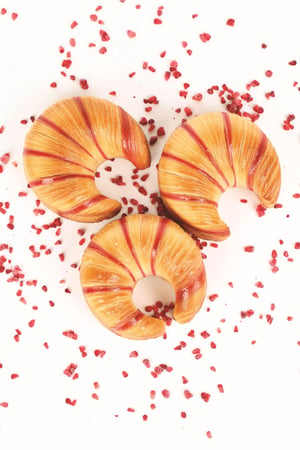 In your opinion, what makes a good viennoiserie? What are the defining criteria?
Thomas Subrin: “If we talk about products made from a laminated yeasted dough, like a croissant for example, in my opinion it’s a viennoiserie that has a crisp texture, beautiful layers, a soft, fine crumb and a good buttery taste.
As for filled viennoiseries, in the same way, you should find a crisp dough and a balance with the filling inside. It must not lean too much towards a cream, which would cause confusion with a pastry, nor be too soft at the risk of bringing moisture to the dough.
Everything depends on the raw materials used to make the filling, their quality and their flavor. The more you move towards lower-quality ingredients, the more you have to compensate on flavor, at the risk of not having a good balance. This means doing several trials. ”
What are the essential ingredients?
TS: “First of all, the flour. It’s a bit of a constant battle. If it is not of good quality, too strong or too weak, you will not get a balanced recipe or a consistent product. This is what will determine the volume and the bite. It must be consistent. Butter is then another essential ingredient, whether for making the dough or for laminating. It must be plastic, with a lovely flavor that will come through in the viennoiserie. If it's too dry, the product will not have the expected taste. Of course, there is the baker’s work, but without good basic ingredients, the result will not be the same."
Are there any techniques that absolutely must be mastered before producing a good viennoiserie?
TS: “For laminated yeasted dough, we are faced with a contradiction: on the one hand we have to give strength to our product so that it has volume and structure, and at the same time we have to give it a certain suppleness by letting it rest to obtain lightness. This therefore requires extensive knowledge of the different stages of production. For laminating, the base temperatures of the dough and the butter must be the same. If the butter is colder, it will be brittle, the layers will be irregular and not crisp.
It is also necessary to respect the fermentation, kneading, and proofing times, which will give the dough structure, strength, and flavor.
With practice, you learn to feel the dough, to put technique into your hands, to check the gluten network (this is what holds the gas during baking; it must be sufficiently extensible while remaining strong so that the product develops properly during baking). Finally, for laminating, everyone has their own way of proceeding depending on the desired result.”
A good viennoiserie has a crisp texture, beautiful layers, a soft crumb, and a good buttery taste.
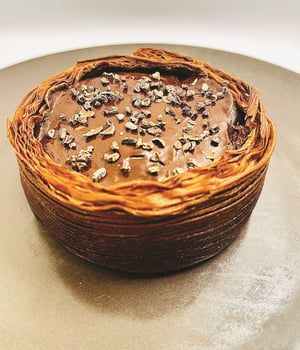 Today we see all types of viennoiserie, with different shapes and appearances. Does the visual aspect matter?
TS: “ Many people prioritize the visual aspect with very open-crumb, Instagrammable viennoiseries, sometimes forgetting the taste. In this case, they only make single turns, the layer of butter will be thicker and the layers more visible. The downsideis that the viennoiserie dries out more quickly. Conversely, if you want to obtain a viennoiserie that will stay soft throughout the day, you will make more turns: the crumb’s air pockets will be smaller, it will be more regular, and it will keep better. ”
What possible developments are there? How do you see the future of viennoiserie?
TS: “Today, we can see that viennoiserie has come back into fashion. It comes in different shapes, different colours, it has been totally reinvented. By filling it, you get a product that is almost a pastry, which you can eat in the street like a snack. It is a crossover between two worlds, that of pastry and that of bakery. It is therefore accessible to all trades: the pastry chef turns towards lamination techniques that they did not necessarily use at the start, and the baker towards pastry notions with the balance of creams and textures.
The possibilities for development are numerous. With new raw materials being launched on the market, such as new texturising agents, for example, the possibilities are numerous. Through my travels, I also find many sources of inspiration abroad, whether in terms of techniques, know-how, or ingredients. Finally, with social networks, it is also easy to share knowledge. The most important thing is to keep in mind that producing beautiful viennoiseries is important, but quality products are even better! ”