- By Charlotte Brown
- May 04, 2026
FROM A FESTIVE DESSERT, MERINGUE AND HEAVY CREAM HAS BECOME ONE OF SWITZERLAND'S BEST-KNOWN SPECIALTIES. THIS IS A COLD-WHIPPED MERINGUE WITH A RICH, SWEET CREAM. ITS HISTORY REFLECTS THE LOCAL LAND AND ENDURING TRADITIONS.
Text by Mégane Fleury - photos by ©La Gruyère tourisme
international cuisine
gourmet delights beyond our borders
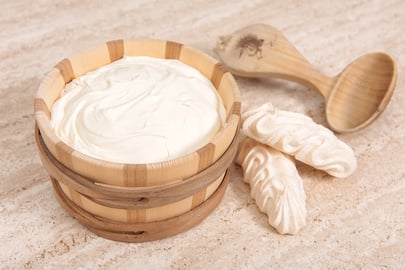
A beautifully arranged meringue, accompanied by a spoonful of thick cream and sometimes a few fruits. Known as meringue and heavy cream, this dessert is a Swiss specialty. What makes it unique is the cream used: made in Swiss alpine pastures, it contains around 45% fat, which makes it both smooth and sweet.
Heavy cream, a product of the Swiss Alps
To trace the origins of this dairy specialty, we need to delve into the history of the region. Heavy cream originated in the Swiss pre-Alps, as did the cantons of Fribourg or Vaud. Historically, it was manufactured by the armaillis, the name given to shepherds in these mountainous areas. "It can be found in places where livestock climb the mountain pastures during the summer," explains Monique Durussel, author of a book entitled "La crème double: du chalet au palais," published by Cabedita, in 2023. Grass-fed cows yield this milk which is then sufficiently fatty to produce the dairy recipe. "The cream is grass and pastures used, as a cheese by-product," she explains. “Before it is made, the milk is left overnight and the lighter cream eventually rises to the surface, meaning it can be collected the next morning.”
 The cream we use contains around 45% fat, making it smooth and sweet
So, depending on where you farm, the type of grass and pastures, the taste of the milk changes, as it does for cream. "This can vary from one mountain pasture to another, as the cream is linked to the land. It's really a kind of life cycle, which takes place between nature and mankind in these mountains.” Originally, shepherds used to eat cream instead of butter, as the herdsmen had to give it to the owner of their land. "Then, this dish was offered to tourists, especially the English, in the 19th century. Gradually, heavy cream gained in popularity, as people spoke of it as something exceptional. To tell the truth, it is quite special: you dip your finger in, and it comes out covered in cream thanks to its beautiful consistency, and its high fat content makes it very sweet," tells the journalist.
While the reputation of this heavy cream has grown, the conditions under which it is produced remain rustic on alpine pastures. "Some things have changed. For example, the men no longer have to spend three months alone on the mountain pastures, because thanks to the 4 x 4, their families can visit them. Yet it remains a hard life. All of the farmers, young or old, are very attached to the mountain pasture. They perceive it as something sacred, and they’re not afraid of the difficult conditions.”
the taste of the milk changes according on where it's raised and the type of grass and pastures used, as does that of the cream
These days, the way the cream is packaged serves as a reminder of its traditional origins. It is generally packaged in small wooden tubs. "It's a sort of interpretation of the life of the herdsmen at the chalet. They used what they had on hand to make the cream, but these are regions where there are a lot of spruce trees, so a lot of things were made out of wood,” she continues. “These small tubs were then developed for tourists.” Monique Durussel notes, however, that their use is starting to disappear for hygiene reasons.
The Benichon Tradition
In the past, farmers would return to their villages at the end of summer, when cows were brought down from the alpine pastures. "We would have a big party, called Bénichon, which means blessing. We’d bless the saints of each village, and there was a big meal, with several meat dishes, which lasted from noon to 8 pm.” Among the specialties were meringue and heavy cream.” The latter is also used to make bricelets, another typical Bénichon delicacy. "They're a kind of tube of dough, very light and crispy, dipped in heavy cream. " Today, Bénichon is still celebrated, but in a different way, "with tastings for example," explains Monique Durussel. Heavy cream now has its own celebration: a festival held in the town of Gruyères
since 2016.
The product is now marketed throughout Switzerland, as much by the producers and dairies as in the supermarkets. "The taste isn’t exactly the same because the mass-produced ones are pasteurized, so that they have a long shelf life. Heavy cream from an artisan producer only keeps for a few days, and its taste evolves," stresses this specialist.
Meringue, a tradition of Swiss craftsmen
Meringues are also made by craftsmen like Thierry Blanc, pastry chef, confectioner and baker based in Bulle, in the canton of Fribourg. “Everyone makes them in the Fribourg and Gruyères region," he advises. Even though specialized companies are producing them in large quantities, they continue to sell well here. We offer them to our customers all year round.” One of the advantages of meringue is its shelf life: "if it is well-packed and kept dry, it retains all of its crunch.” To achieve this, the craftsman recommends bagging meringues immediately after baking, and If not, storing them in the oven until packaging. To enjoy, customers simply have to place the cream and meringue on a plate!