- By Charlotte Brown
- February 10, 2026
THEY SAY GLUTTONY IS A BAD HABIT NOT FOR JONATHAN MOUGEL, FOR IT HAS LED HIM TO BECOME A MEILLEUR OUVRIER DE FRANCE PÂTISSIER-CONFISEUR, RECOGNIZED BY HIS PEERS FOR BOTH HIS CREATIONS AND HIS TECHNICAL ARTISTRY. TODAY, THE CHEF TRAVELS THE WORLD WITH HIS CONSULTING COMPANY.
Text by Séverine Perrotte
More than a Trade, an Art
When the Mastery of a Trade Becomes an Art
 Jonathan's first steps in pastry-making came at a very early age, in his parents' kitchen, where homemade tarts and carnival donuts were made under his mother's watchful eye. A foodie by nature, he obtained a role at the Perret patisserie, where he would spend every day for his third year work placement. Convinced that this was the trade for him, in 1997, he decided to undertake a 2-year B.E.P. and C.A.P. in Gérardmer, an initial apprenticeship supplemented by experience in chocolate- making and catering. Yet it was his B.T.M. exam with Mr. Chaboissier that was the trigger. "I entered my first regional and national competitions, which enabled me to start working with sugar and develop a taste for a job well done. All this, combined with reading professional journals, made me want to take the M.O.F. exam one day.” His boss at the time, Mr Pierrel, urged him to continue his studies until he obtained his Brevet de Maitrise in Nancy.
I signed up for my first regional and national
competitions, which helped me develop a taste for a job well done
 With his diploma in hand, the following year he joined the company PatisFrance (now Puratos) as a trainer, as well as working in Research & Development. “Through these demonstrations, I discovered France and the world. I've also met a lot of new people.” One in particular will go on to change his life, that of Stéphane Leroux, M.O.F. pâtissier, who tells him about the competition and offers to help. He signed up in 2013, passed the selections and reached the final in 2015. "It didn't work out that first time, the bar was too high. I fell apart artistically and went home disappointed. However I've come to appreciate the beauty of this competition. Isn't it often said that only those who take part can understand?” Far from being defeated, his competitive spirit drove him to sign up again. The final takes place in October 2018. "I went in with a totally different approach, I had matured, having learned to handle my emotions. I test as many things as possible so that I'm ready on the day. I've also come to realize that training is important, but that the solid foundations acquired from a very young age will guide you through this fantastic experience. I added some physical training and a little nutrition program and I was ready! My job has always taught me to adapt, and this was the case in this unknown pastry kitchen for 31 hours!” Relief came on October 20, 2018 with the announcement of the results. Modest, Jonathan believes he has had a simple career, but with a strong desire to progress. "Anyone can do it!”
I realized that training is important, but solid foundations are the best guide
 Even if, according to the chef, the artistic element has not always been present, it now takes precedence in every one of his creations, right down to the design of a cupcake or a chocolate decoration. "I think it's best to master the basics, work carefully and achieve the best taste possible, but I've always been curious about the technical and artistic part. Seeing sugar or chocolate pieces at fairs, in competitions or in magazines developed my desire and I was soon drawn to a piece of pastillage, a ribbon or the material we're trying to copy. I was quick to make pieces when I was young, and I've always been well versed in pulling sugar to dress up a pièce montée, for example. Now, maturity helps me think about how to put together a piece, based on what interests, moves, and surprises me. I also feel more comfortable with my color choices, for example.
The artistic section is a big part of the competition for a Meilleur Ouvrier de France. It's a collection of elements that come together to form the prettiest piece. It's more than a pretty flower, or a beautiful chocolate structure, it's more than a new technique or a piece bigger than the Eiffel Tower, it's above all emotion, sensitivity and the guidelines of the art, like painting and sculpture. Sugar, chocolate and pastillage all require dexterity, mastery, know-how, research and interpersonal skills. It’s important to remain modest in the face of this rich heritage passed down by our peers. You have to get to grips with the material, work with it, so as to feel at ease with it and discover its infinite possibilities."
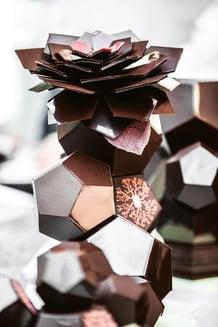
Most of my inspiration comes from nature, geometry and the material
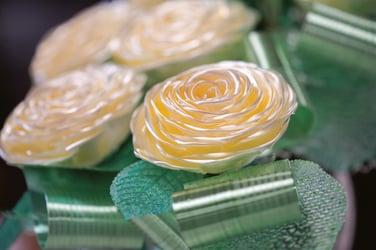
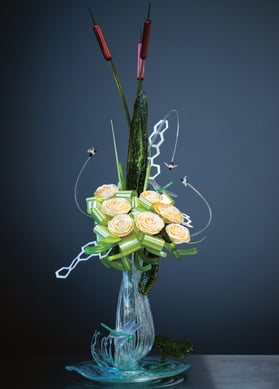 Sugar or chocolate? It's hard for the pastry chef to choose: "I'm a huge chocolate fan! What could be more artistic than watching the movements of chocolate on marble under a spatula, or even under a microscope during an unruly setting process? But it's true that I've been favoring artistic work with sugar pieces lately. This material is quite addictive, magical. I particularly appreciate work with transparency or when the satin is outlined against a rose or a ribbon." Among the qualities possessed by the chef, curiosity and motivation are two important aspects to develop when starting out in the artistic field: "I think you already need to have an interest in worlds other than your own. Art requires hours of work to achieve your goal. It’s also necessary to challenge yourself. Drawing and tinkering before starting work on a sugar or chocolate piece remains important. You have to be patient, rigorous and courageous."
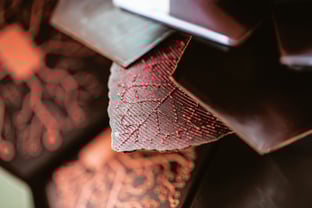
When it comes to inspiration, Jonathan has many sources: "Most of my inspiration comes from nature, geometry and the materials themselves. They offer so many projections and ideas. Nature is fascinating. Colors, shapes and textures, it's all there. The five elements also make it easy to find inspiration and help you design a piece or an element. I also seek out artistic appeal through sculpture, modern or ancient architecture, but also what happens in the minimalist or infinitely small; on a cellular level, for example. I discovered the Voronoi diagram while working on the dragonfly of the sugar piece in the final. It's mind-blowing to see and understand how geometry works on a minute scale."
Over the years, Jonathan has managed to find his own style, making his mark on the art world with his delicate, transparent
creations... "I'm fully oriented towards very manual work, without too many molds, which is often a big challenge. I use sugar modeling to create unique volumes as well as solidity. I'm also a fan of panoramic work, which I presented for the first time at the M.O.F. finals in 2018. The ‘floor’ space is another way of approaching working on a piece. The design is different. This can easily be integrated into a large space such as a painting. I work on the color style too, I want them to be unique, sometimes surprising."
If the chef has any advice for those who want to get started: "You have to be interested in and open to all forms of art, and draw some inspiration from literature and history. Traditional crafts are also inspiring, like engraving, which I now use all the time. Working with the material on a daily basis is important, not only to become familiar with it, but also to discover new techniques. Lastly, it's important to sign up and participate in competitions for rapid progress." For Jonathan, the artistic side of the business still has a bright future ahead of it, thanks in particular to developments in techniques, equipment, rapid mold design and the number of competitions in France.