- By Charlotte Brown
- September 03, 2026
Text by Éric Birlouez - photos by Xavier Ferrand
Croissants, pains au chocolat or au lait, apple turnovers, pain aux raisins, brioches… Today, these treats are so popular with our fellow citizens that they no longer enjoy them only at breakfast, but throughout the day.
But do they know that these products, emblematic of our French gastronomy, actually come from Austrian… bakery? Which is why they are grouped together under the general name viennoiserie, which refers to bakery products whose production technique is similar to that of bread (yeasted dough) or puff pastry dough, but which use the usual pastry ingredients (sugar, milk, cream, butter, eggs, etc. ).
Parisians were the first to discover viennoiseries, thanks to an officer of the Austrian embassy in Paris named August Zang. In 1838, this diplomat decided to change careers, opening a shop he called Boulangerie viennoise, on rue de Richelieu. He offered Parisians two new products: the Kipferl (the ancestor of our croissants) and the Kaisersemmel (our pain viennois, which was originally round in shape). Their particular texture and taste are obtained by adding sugar and a small amount of milk during kneading. These new products immediately won over the inhabitants of the capital, and two years later, twelve Parisian bakeries were already making pain viennois and croissants. Other products of the same type would gradually appear, but the generic name viennoiseries would only be used from the beginning of the 20th century.
Besides the recipes, the techniques themselves were also imported from Austria. In the Report of the jury of the 1878 Universal Exhibition in Paris, the writer mentions “an excellent ferment, which is compressed starter; the use of this yeast is a necessity for Austrian flours, which are very strong, as well as for semolina flours from Hungary. ”Another innovation lies in the use of a new type of oven, the Viennese oven, which allows the steam to create a glaze on top of the product. Compared with the traditional oven, the opening is smaller and the deck is sloping: “these arrangements are intended to promote the action of the steam that escapes from the bread during baking, and which greatly contributes to giving the crust an attractive colour."
The steam in the viennoiserie oven creates a glaze on the top of the product.
In France, croissants now represent 40% of the viennoiserie market (compared with 35% for pains au chocolat). According to legend, its shape is linked to the siege of Vienna by the Ottoman Turks in 1683. To seize the city, the latter are said to have dug tunnels under the walls at night. But the bakers heard the pickaxe blows and raised the alarm, which saved the imperial city. As a reward, they were granted the privilege of selling small breads whose shape represented the crescent moon shown on the flags of the Ottoman armies.
In reality, cakes with this shape and made with a yeasted dough (but not puff pastry) had already existed in Austria for several centuries… The word croissant would appear in a French dictionary in 1863. At that time, it looked like a brioche-type bread: it was only in 1906 that the current recipe was published: that of a butter dough, both yeasted and laminated. Pain au chocolat is the other star viennoiserie in our bakeries. Also very common, pain aux raisins is a sweet, yeasted puff pastry dough filled with Corinth raisins and pastry cream. The dough has been rolled into a spiral, hence the name escargot that is sometimes given to it. Bakers also offer pains viennois (now elongated in shape), small milk breads as well as apple turnovers (see the article on page 16).
Pain au chocolat, chocolatine or petit pain?
The term petit-pain au chocolat appeared in the 1920s, without it being possible to say whether it refers to a small bread into which a bar of chocolate has been slipped, or to the viennoiserie in question here. From the 1970s onwards, the adjective petit began to disappear (it has only been retained in three départements: Nord, Pas-de-Calais and Haut-Rhin). As for the word chocolatine, it is mentioned in a press article as early as 1853… but to refer to a kind of chocolate sugared almond. Then it was applied to various products such as a “liqueur made from chocolate” or a “chocolate made from cocoa and grape sugar”. It was only in the early 1950s that, in a magazine from south-west France, chocolatine referred to a “chocolate viennoiserie”. This is the term that most inhabitants of the Nouvelle-Aquitaine and Occitanie regions use today to refer to pain au chocolat.
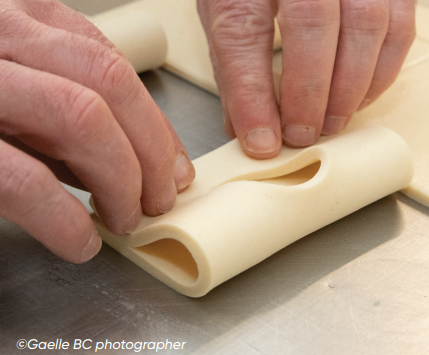 Also part of the viennoiseries are the Parisian brioche (or brioche à tête, a small ball of dough sitting on top of another, larger one) as well as the Berliner (the brioche dough filled with jam or pastry cream is plunged into a bath of frying oil). The oranais, also called lunette aux abricots, is a brioche or puff pastry filled with pastry cream, topped with two apricot halves and sprinkled with pearl sugar. Its name suggests that it was created in the city of Oran, from where repatriates from Algeria are said to have brought it back to France. The palmier, the heart-shaped puff pastry dough coated with caramelized sugar, is said to have been created for the 1931 Colonial Exhibition, which honored this tropical tree. Slightly less common is the sacristain (its shape evokes the sacristan’s cane), a stick of puff pastry dough twisted into a spiral and sprinkled with chopped almonds and sugar. Rectangular in shape, the suisse is a brioche dough filled with vanilla pastry cream and chocolate chips. To conclude, let us mention a regional viennoiserie known as far away as the United States: the kouign amann, whose paternity is claimed by the inhabitants of Douarnenez, in Finistère.