- By Charlotte Brown
- September 03, 2026
Text by Mégane Fleury - photos ©Grains de vanille
In Belgium, brioche is an essential product in the bakery. Alongside the classics, there are two Belgian specialties: cramique and craquelin, whose recipes are similar.
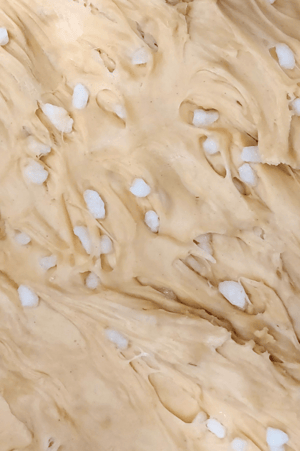 Belgium is a land of bread. As proof, there is roughly one bakery per 1,897 inhabitants, compared with one per 1,800 inhabitants in France. Artisan Belgian bakers offer their own specialties, including several brioches. Two of them are particularly widespread in the country: cramique and craquelin.
Two similar recipes, but two very distinct products.
“Craquelin is a large brioche with butter and sugar,” explains Andy Verstraeten, head of the bakery Grains de vanillein Rixensart, near Brussels. You'll find large pieces of pearl sugar inside and also on top. In Belgium, we use P4 or P5 sugar, which corresponds to C40 or C50 in France." As for cramique, it is also known to the inhabitants of northern France. This recipe is similar to that of craquelin, but the traditional version contains raisins. “The shaping is also different; cramique is slightly elongated. This brioche is then baked in a bread tin."
Initially, cramique was a medium of exchange.
The ancient history of cramique in Belgium
The term cramique has been noted in Belgian works for several centuries. Sometimes called kramiek, it is described as a small bread enriched with butter, milk and sugar and filled with raisins. Its recipe has, however, evolved over the ages. Initially known as cramiche, it was used as a unit of exchange. Its weight and value made it possible to use it as a means of payment. Cramique is referenced in texts from 1831, and the brioche seems to have become established in the country’s gastronomic landscape. Originally, this was a product typically enjoyed for Christmas and New Year’s Eve, but it can now be found all year round in Belgian bakeries.
“The dough is a little less rich than that of a classic brioche dough,” advises Andy Verstraeten. The brioche is more often eaten in its sweet version, at breakfast or for a snack, but some people use it for savory recipes. It can be used, for example,
to accompany foie gras." Other artisans choose to prepare variations on the classic recipe: some replace the raisins with chocolate chips, for example.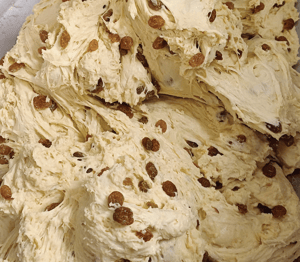 Craquelin, a brioche with pearl sugar
Craquelin, on the other hand, is always offered in a plain version with pearl sugar. However, like cramique, it is usually reserved for special times of the year. In the Borinage region, west of Mons, it is prepared for Christmas, along with other specialties. In Grammont, a town located west of Brussels, craquelin has been at the heart of a festival for centuries. This recalls the siege that surrounded the town several centuries ago. Each year, at the end of February, a procession of a thousand people in historical costumes parades through the town. When the procession ends, local officials are responsible for perpetuating the ritual of launching several thousand craquelins into the crowds. The crowd gathered in the street tries to catch as many as possible.
Only one of these contains a short message: its lucky holder wins a golden craquelin, a piece of jewelry made by a local artisan. This tradition of throwing craquelins comes from a local legend. When the town of Grammont was besieged in the 14th century and famine threatened, the municipal leaders had the idea of tricking their opponents in an attempt to avoid occupation. They had leftovers of bread and fish thrown over the town walls to make it look like the population was living in abundance. The official story tells us that in reality, the town suffered a heavy defeat, but this legend lives on.
Other bakery specialties from Belgium
While cramique and craquelin are certainly their best-known brioches, Belgium offers other bakery specialties. For the end-of-year festivities, it is common to find cougnous: small brioches in the shape of baby Jesus. Like the two other brioches, these can be plain, with pearl sugar, or with raisins. This ingredient is also used in bolus. Also known as baulus,this product is traditionally spiral-shaped.
Belgium also has a few iconic viennoiseries, including the couque. Similar to the croissant, it is made using puff pastry dough. “Shaped into a diamond, rolled slightly, then coated with sugar syrup,” adds Andy Verstraeten. It can also be made with chocolate or raisins. Simple yet indulgent products, highly appreciated by Belgian customers.
Andy Verstraeten
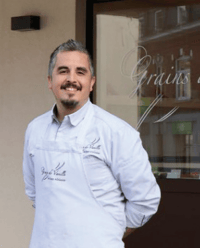 GRAINS DE VANILLE, RIXENSART (BELGIUM)
Andy Verstraeten and Stéphanie Martin opened Grains de vanille in Rixensart, south-east of Brussels in 2016. Before this, the trained pastry chef had a variety of professional experiences. After a few years in the Belgian capital, he went to work in
Japan, before returning to obtain a position as a pastry chef in a Michelin-starred restaurant. He deepened his knowledge of baking within the establishment SaintAulaye, still in Brussels. Passionate and motivated, Andy Verstraeten has already
participated in competitions, including the World Chocolate Masters. He now devotes himself entirely to his business. At Grains de vanille, the chef offers his own creations in store. The entire range of breads is made with starter, using local flours. For pastries, he favors seasonal products.