- By Charlotte Brown
- September 03, 2026
Text by Eric Birlouez
Eaten warm or cold, this treat is enjoyed by all food lovers at snack time or breakfast. This crisp puff pastry dough in the shape of a semi-circle and filled with a very soft apple compote is a real delight.
APPLE TURNOVER
The subtle combination of puff pastry and apples
Alongside the croissant, pain au chocolat and pain aux raisins, the apple turnover belongs to the large family of puff pastry dough viennoiseries whose production, despite its apparent simplicity, requires great skill on the part of the artisan. The apple turnover has been mentioned since 1780 in the Dictionnaire du chevalier de Jaucourt: the author defines it as a “kind of apple pie."
But this type of pastry already existed two centuries earlier: at the end of the 16th century, Lancelot de Casteau, head cook to the prince-bishops of Liège in Belgium, had developed the recipe. Published in 1604 in his treatise entitled “Ouverture de cuisine”, this medieval turnover consisted of a round sheet of puff pastry dough folded in two over a filling of quinces and ground almonds.
The word chausson comes from the Latin calceus, meaning “shoe”. Dated 1962, the Dictionnaire de l’Académie des Gastronomes specifies that “the chausson was formerly a kind of moccasin that enclosed the foot inside the shoe or boot; this name was given to a puff pastry enclosing a filling over which the dough is folded and sealed before going into the oven."
The apple turnover has been listed since 1780 in the Dictionnaire du chevalier de Jaucourt
From the apple turnover to “falling in the apples”
This expression has nothing to do with apples! It is the result of a linguistic distortion from another expression widely used in the Middle Ages: “tomber dans les pâmes." The word “pâme” came from the verb “se pâmer," which meant to lose consciousness. While “tomber dans les pâmes” has disappeared, the literary form “tomber en pamoison," formed in the 17th century, is still present in the French language with the same meaning as “tomber dans les pommes."
The world capital of the apple turnover is in the Sarthe
The apple turnover is emblematic of Saint-Calais, a town of 3,000 inhabitants located in the Perche area (Sarthe department). The town has dedicated a popular festival to it: every first Sunday in September, a large event is organized during which thousands of apple turnovers are made and sold. The filling of the puff pastry dough consists of large pieces of apples softened in butter with added sugar and cinnamon. The shiny appearance of the turnover is obtained by sprinkling it with sugar as soon as it comes out of the oven.
A gourmet fellowship, created in 1992, now organizes this Apple Turnover Festival. The original religious procession has been replaced by a weekend of festivities: a grand parade of members of the brotherhood and invited brotherhoods, turnovers made by the town’s bakers, street performances, craft market, exhibitions, etc.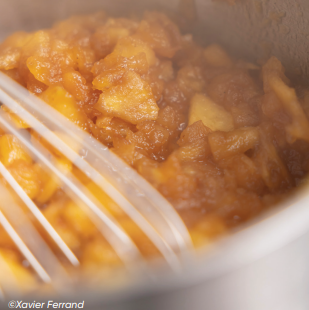 A lovely legend
In Saint-Calais, they say that in 1630 – or 1580 according to other versions – a terrible epidemic of plague (or dysentery) ravaged the region and killed two out of three inhabitants of the town. The local lady of the manor is said to have decided to feed the inhabitants who were confined (already!) within the city walls to avoid spreading the disease. For them, she
is said to have had a gigantic “apple pie” made. In 2024, the town of Saint-Calaistherefore celebrated the… 394th edition of
this apple turnover festival.
Turnovers Reimagined
The apples, in the form of compote or a mixture of compote and pieces of roasted apples, are sometimes replaced by an apple-pear mixture or by other seasonal fillings: apricot, strawberry, red berry, rhubarb, peach, etc. Some bakers and pastry chefs pay close attention to the variety of apples they use (Canada, Pink Lady, Golden, Granny Smith or old varieties such as Reinette) as well as their origin (local) and production method (organic).
The quality of the butter used is also essential. The apples may sometimes be raw, but in that case they are macerated for at least 24 hours. They are often flavored with vanilla or cinnamon. Lastly, the crust may be more or less caramelized, sprinkled with brown sugar or powdered sugar.
Note also that the chausson aux pommes sometimes becomes a chausson à la pomme: the puff pastry dough then wraps a whole apple while still keeping the traditional shape of the viennoiserie.
The apples are sometimes replaced by an apple-pear mix or other seasonal fillings.
Dictionnaire gourmand. Marie-Hélène BAYLAC. Editions Omnibus. 2014 Dictionnaire de la gourmandise. Annie PERRIER-ROBERT. Robert Laffont. 2012 Various websites.