- By Charlotte Brown
- September 03, 2026
Text by Mégane Fleury
Created for a competition, the Alsatian Pogne has become the specialty of the Hertzog bakery in Alsace. This brioche is a cross between different influences, from panettone to the pogne de Romans.
Alsatian Pogne
Reimagined Regional Specialty
 September 2020. Roland Hertzog, an Alsatian baker-pastry chef, is taking part in the 31 second speed pogne and ravioli festival in Romanssur-Isère in the Drôme. This year, the town decided to take advantage of the event to organize a French championship of regional brioche.
Reserved for professionals,whether bakers or pastry chefs, the competition includes two tests: the presentation of a regional brioche and the on-site making of a reimagined pogne. The Alsatian craftsman decided to present the langhopf, a brioche flavored with cinnamon, almonds, hazelnuts, walnuts, and rum raisins.
For the creation element, he chose to reimagine the pogne by adding raisins and an almond macaronade. His two products enabled him to win the title of French Champion of regional brioche. And so was born the Alsatian pogne, still made in the chef's establishment, who passed away three years ago.
The Alsatian pogne was born in September 2020 at the French championship of regional brioche.
A cross between kouglof and panettone.
“For the Alsatian pogne, we took what was best in our regional brioches,” says Samuel Kloepfer, who took over the shop in 2021. According to him, it's a cross between kougelhopf, another Alsatian specialty, and the panettone of their Italian neighbors, “because it is a soft brioche with a long shelf life. The latter is linked to the production method. Mr. Hertzog was an Ambassadeur du Pain and used the respectus panis method,” he continues. “I have kept this way of working. This involves carrying out long fermentations to obtain lower glycemic indexes and better nutritional value. In a way, it's about giving ourselves time again, rather than making bread quickly." Concretely, it takes three days to make an Alsatian pogne, which will then keep for four to five days.
It is a soft brioche with a long shelf life, linked to the respectus panis.
A brioche made from a yeast starter
The first step is making a yeast starter. “We mix water, yeast and flour, then let it ferment. We then have to work this dough again to increaseits strength.” This recipe contains the basic ingredients of this reinterpreted brioche: this makes it possible to reduce the amount of yeast used in the recipe. “On average, bread recipes recommend using between 20 and 40 grams of yeast for one kilogram of flour. Using the respectus panis method, we demonstrate that it is possible to have a good brioche with only 1 gram of yeast per kilogram of flour." According to Samuel Kloepfer, beyond the nutritional benefits, this makes it possible to obtain a beautiful crumb texture while offering a good development of flavor. “Above all, we're still looking for indulgence; it is still a fine buttery brioche."
It takes a full day to carry out the different kneading stages
A recipe with multiple steps
After making the yeast starter, comes the kneading. “You need to allow a day to carry out the following stages, because
this is not a kneading carried out in one go with nothing more to doafterwards,” warns the Alsatian artisan. You have to make folds, let it rest, and make folds again. This makes it possible to obtain more strength in the dough, since there is very little
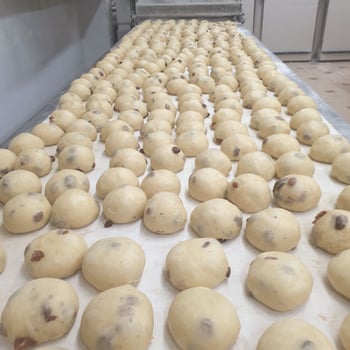
yeast."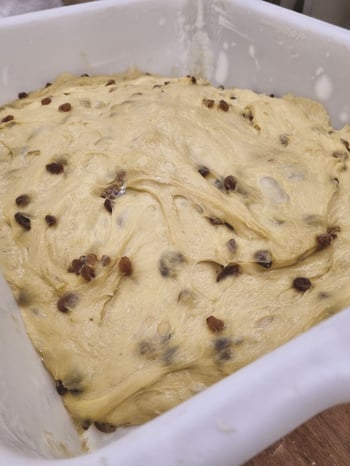 Then, it must be left to proof in containers before starting shaping. The pieces of dough are divided, rounded and rest for another hour before being shaped into a ring. “We use our elbows for this,” confides the baker pastry chef. We place the ball on the work surface, then with a movement of the elbow in the middle, we obtain a beautiful, even ring. "
A final fermentation in the proofing chamber concludes these three days of work, followed by baking. “This recipe is not complicated,” he reassures. On the other hand, you have to be organized and have enough time."
The many variations of the Alsatian pogne
Every day, large quantities of Alsatian pognes are made by the Hertzog bakery teams, before being sold in the three boutiques. “I couldn’t estimate the exact number,” says Samuel Kloepfer, “but customers really like it." Faced with this
success, his former boss pushed creativity further by inventing variations: Alsatian pogne filled with pralines, chocolate chips, or a festive end-of-year version.
“In Alsace, we love spices, so we created a pogne with Christmas spices and candied chestnuts. On top, there is an almond macaronade and some chestnut pieces." During Epiphany, the teams make a pogne similar to a king’s brioche, filled with homemade candied fruit. “The classic version is still the one people like best,” he concludes.